Building a Barn in the Peace Region
Choosing the Right Barn Type
Not all barns are the same, and the type you build should match what you're actually using it for. Here are the most common types we build for ranchers and farmers across the Peace Region:
- Equipment and hay storage barns: These are the workhorses. Open or enclosed, they keep your machinery, hay, and feed out of the weather. Usually unheated and built as large as your budget allows.
- Livestock barns: Cattle shelters, calving barns, and general livestock housing. These need good ventilation, durable flooring, and easy access for feeding and cleaning.
- Horse barns: Stall layouts, tack rooms, feed storage, and often a heated area. Horse barns tend to have higher finishing standards and more interior detail than a typical farm building.
- Farm shop buildings: A combination barn and workshop. These are popular with farmers who need a space to repair equipment, weld, and store parts alongside their agricultural operation. Check out our shop construction page for more on these.
Post Frame: The Go-To Building Method
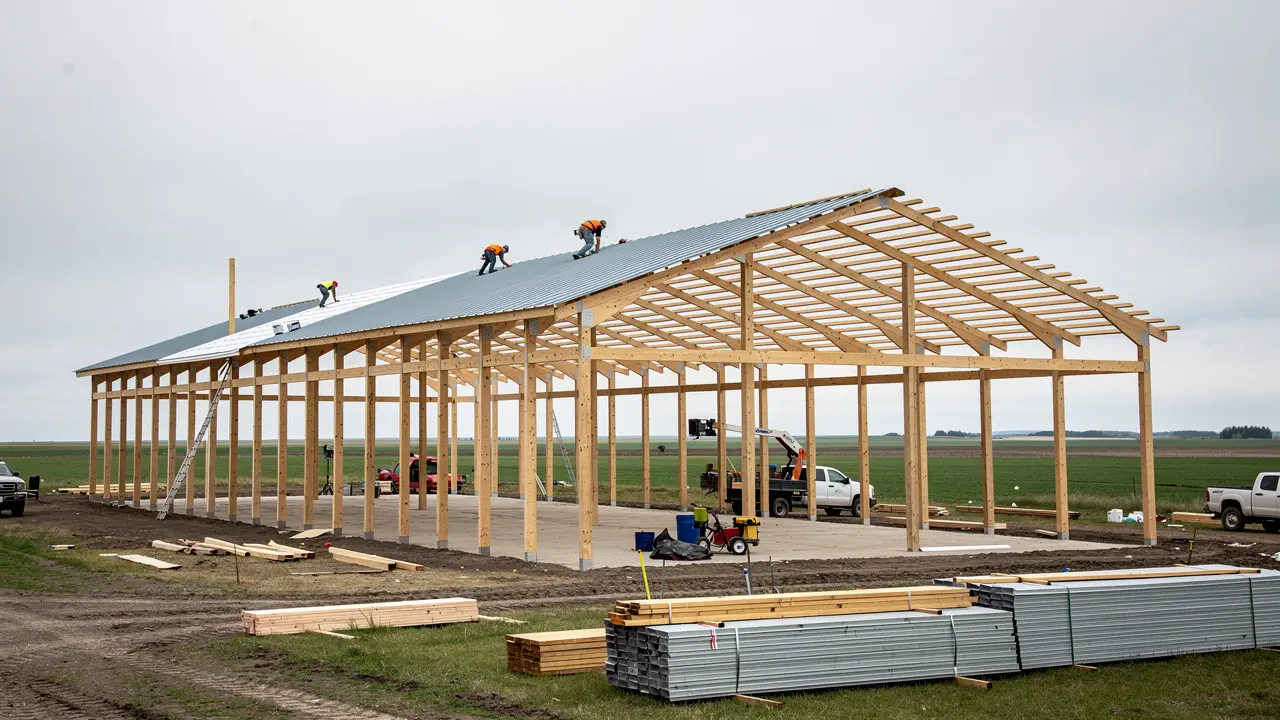
Post frame construction (also called pole building) is the standard method for barn construction in the Peace Region, and for good reason. Structural posts are set into the ground or mounted on concrete piers, and the wall and roof framing attach directly to those posts. This creates a clear-span interior with no internal load-bearing walls getting in the way.
Post frame buildings go up fast, cost less per square foot than conventional framing, and handle the heavy snow loads we get in northern BC. For most agricultural buildings, post frame is the most practical and economical choice.
For larger or more specialized barns, steel frame construction is another option. It offers wider clear spans and greater durability for heavy-use buildings, but comes at a higher cost.
Foundation Options
Your foundation choice depends on the barn type, soil conditions, and whether you need a concrete floor.
- Posts in ground: The simplest approach. Pressure-treated posts are set directly into augered holes with compacted gravel. This is cost-effective for basic storage barns and keeps the budget down.
- Screw piles: Screw pile foundations are a great upgrade from posts in ground. They install quickly, work in frozen ground, and provide a stronger, more permanent foundation. We recommend screw piles for any barn you want to last decades.
- Concrete piers and slabs: For heated barns, livestock barns, or any building that needs a concrete floor, a poured slab with thickened edges or individual concrete piers under posts is the way to go.
Size and Layout Considerations
Build bigger than you think you need. That's honest advice from building barns for years. Whatever size you're planning, you'll fill it and wish you had more room.
Common barn sizes in the Peace Region:
- Small barns: 30x40 to 40x60 feet. Good for a few horses, hay storage, or a small equipment bay.
- Medium barns: 40x80 to 60x80 feet. The sweet spot for most mixed-use farm buildings.
- Large barns: 60x100 feet and up. Equipment storage for large operations, commercial livestock, or combination buildings.
Think carefully about door placement and access. Sliding doors, overhead doors, and man doors should be positioned for how you'll actually move equipment, animals, and feed in and out. A 16-foot overhead door is standard for most farm equipment. If you're running larger combines or headers, you may need 18 or 20-foot doors.
Insulation and Ventilation
If your barn is heated, or if you're housing livestock, insulation and ventilation are critical.
For heated barns and farm shops, spray foam insulation is the best option. It seals the building envelope, prevents condensation, and delivers the highest R-value per inch. In a -40 climate, skimping on insulation costs you every month in heating bills.
Ventilation matters just as much. Livestock barns produce moisture, ammonia, and heat. Without proper ventilation, you get condensation on the underside of the roof, which leads to dripping, rust, and rot. Ridge vents, eave vents, and mechanical fans keep air moving and moisture under control.
Even unheated storage barns benefit from basic ventilation. Air circulation reduces condensation and helps protect stored hay and equipment from moisture damage.
Cost of Building a Barn
Barn construction costs in the Peace Region depend on size, type, and finishing level. Here are rough ranges:
- Basic unheated storage barn (post frame): $25 to $45 per square foot. A 40x60 storage barn might run $60,000 to $108,000.
- Heated farm shop barn: $50 to $80 per square foot. Insulation, concrete floor, heating, and electrical push the cost up. A 40x60 heated barn could be $120,000 to $192,000.
- Horse barn with stalls and finishing: $60 to $100+ per square foot depending on the number of stalls, tack room, wash bay, and finishing details.
- Large equipment barn (60x100+): $20 to $40 per square foot for basic cold storage. The per-square-foot cost drops with size.
These are ballpark numbers. Site access, soil conditions, and material prices all affect the final cost. The best way to get an accurate price is to call us and talk through your project.
Frequently Asked Questions
Do I need a permit to build a barn?
It depends on your location. Properties within city limits (Dawson Creek, Fort St. John) require building permits. In the Peace River Regional District, requirements vary by electoral area. Farm buildings on ALR land generally have fewer restrictions, but you should still check with your local authority. As your general contractor, we can advise on what's required for your property.
Can you build a barn in winter?
Yes. Post frame construction and screw pile foundations both work in frozen ground. We regularly build through Peace Region winters. Concrete work is the main thing that needs warmer temperatures, so if you need a poured floor, we plan around that.
How long does it take to build a barn?
A basic unheated storage barn can be standing in 3 to 6 weeks. A heated barn with concrete floor, insulation, and electrical typically takes 8 to 14 weeks. Site prep and permit timelines add to the front end.
Post frame or steel frame?
Post frame is more economical and works great for most farm buildings up to about 60 feet wide. Steel frame is better for very wide clear spans, heavy-duty commercial use, or buildings that need to meet specific engineering requirements. We build both.
What about barn construction on uneven ground?
Screw piles handle uneven terrain well because each pile can be cut to a different height to create a level building platform. Post frame buildings can also be stepped to follow the grade. We assess your site and recommend the best approach.