Frost Depth and Snow Loads in Northern BC
Why Frost Depth and Snow Loads Matter
If you're planning to build anywhere in the Peace Region, two numbers will shape almost every decision about your foundation and roof: frost depth and snow load. Get either one wrong, and you're looking at cracked foundations, heaving floors, or a roof that can't handle what winter throws at it.
These aren't suggestions. They're building code requirements, and your engineer and building inspector will hold you to them. Understanding what the numbers mean helps you make better decisions about your project from day one.
Frost Depth in the Peace Region
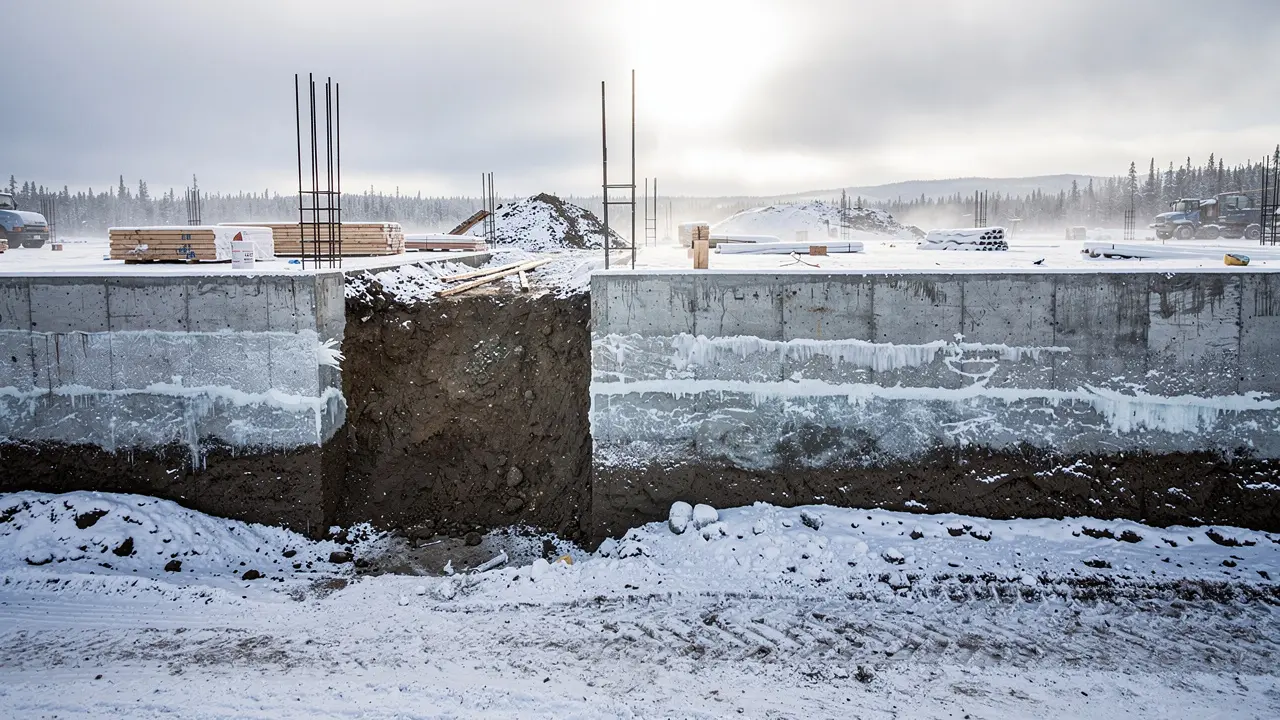
Frost depth is how far below the surface the ground freezes in winter. In the Peace Region, that's deep. Typical frost depths run between 6 and 8 feet depending on location, soil type, and snow cover.
Here's what you can expect in the communities we serve:
- Dawson Creek: 6 to 7 feet typical frost penetration
- Fort St. John: 6 to 8 feet, with deeper penetration on exposed sites
- Chetwynd: 5 to 7 feet, slightly moderated by elevation and snowfall
- Hudson's Hope: 6 to 7 feet
- Tumbler Ridge: 5 to 7 feet
These are general ranges. Actual frost depth on your specific site depends on soil moisture content, drainage, vegetation cover, and how much snow insulates the ground in a given winter. A cleared, exposed lot with wet clay soil will freeze deeper than a sheltered, well-drained site.
How Frost Heave Damages Buildings
When water in the soil freezes, it expands. That expansion creates upward pressure called frost heave. If your foundation sits within the frost zone, the ground will push it upward in winter and let it settle back down in spring. This cycle repeats every year, and it's not gentle.
Frost heave causes cracked concrete slabs, doors and windows that won't close, uneven floors, and structural damage that gets worse over time. The solution is straightforward: your foundation needs to extend below the frost line, or use a system designed to resist heave forces.
Screw pile foundations are one of the most effective solutions in our region. Piles are driven 10 to 25 feet deep, well past the frost line, and anchored into stable soil. They resist both the uplift force of frost heave and the downward settlement that follows. For a closer look at how they work, see our screw pile foundations guide.
Concrete foundations also work well when designed for our conditions. Footings must be placed below the frost line, and the concrete needs to be properly cured, which can be challenging during winter pours.
Snow Load Requirements
Snow load is the weight of accumulated snow and ice your roof must be engineered to support. The BC Building Code assigns specific ground snow load values to each community, and your roof structure has to be designed accordingly.
Typical ground snow loads in the Peace Region:
- Dawson Creek: approximately 1.8 kPa (37 psf)
- Fort St. John: approximately 1.7 kPa (35 psf)
- Chetwynd: approximately 2.4 kPa (50 psf)
- Tumbler Ridge: approximately 2.8 kPa (58 psf), among the highest in the region
- Hudson's Hope: approximately 2.0 kPa (42 psf)
Your roof's design snow load is calculated from these ground values using factors for roof shape, slope, exposure, and potential for drifting. A flat-roofed shop will have different requirements than a steeply pitched home. Areas where snow drifts against a taller wall or collects in a valley need extra capacity.
How Snow Loads Affect Roof Design
Meeting snow load requirements comes down to your roof's structural members. Trusses, rafters, purlins, and connections all need to be sized for the load. In practice, this means:
- Heavier lumber or closer truss spacing than you'd see in milder climates
- Engineered trusses designed specifically for your building's span and load
- Steel framing for larger shop and commercial buildings where spans are wider
- Proper bracing and connection details that transfer the load all the way down to the foundation
Roof slope matters too. Steeper roofs shed snow more easily and carry lower design loads. But steep roofs aren't always practical, especially on large shops or commercial buildings. Your engineer balances slope, span, and material to meet code while keeping the project cost-effective.
Building Code Requirements
The BC Building Code and National Building Code of Canada set the rules. For the Peace Region, key requirements include:
- Foundation depth: Footings must sit below the frost line, or use an approved frost-protected design
- Snow loads: Roof structures must meet or exceed the specified ground snow load for your location
- Wind loads: Northern BC also sees significant wind, which can combine with snow loads to increase design requirements
- Engineered drawings: Most structures in the Peace Region require stamped engineering that accounts for local climate data
Your building permit application will include these calculations. If you're working with a general contractor who knows the region, they'll handle this coordination with the engineer. If you're owner-building, make sure your engineer is using the correct climate data for your specific location.
Planning Tips for Northern Builds
A few practical things to keep in mind when you're planning a build in the Peace Region:
- Get a soil report: Soil conditions vary a lot even within a single property. A geotechnical report tells your engineer exactly what's down there and how deep the foundation needs to go.
- Plan for drainage: Wet soil freezes deeper and heaves harder. Good drainage around your building pad reduces frost depth and protects your foundation long-term.
- Consider your roof early: Snow load affects truss design, which affects wall height, which affects your budget. Don't leave roof engineering until the last minute.
- Build with a local crew: A builder who works in the Peace Region year-round understands these conditions firsthand. That experience shows up in better details, fewer problems, and a building that holds up over time.
Frequently Asked Questions
What happens if my foundation isn't deep enough?
If footings are above the frost line, the freeze-thaw cycle will push and pull them every year. Over time, this causes cracks, uneven settling, and structural damage that's expensive to fix. It's always cheaper to build it right the first time.
Can I use a shallow foundation in northern BC?
Frost-protected shallow foundations are an option in some cases. They use rigid insulation around the perimeter to keep frost from reaching the footings. However, they require careful design and aren't suitable for every site. Talk to your engineer.
Do I need to remove snow from my roof?
If your roof is properly engineered for the local snow load, you shouldn't need to clear it under normal conditions. However, in unusually heavy snow years, or if drifting causes uneven accumulation, it's worth keeping an eye on things. If you're unsure, call a professional.
How do I find the exact snow load for my property?
The BC Building Code lists ground snow loads by community. Your engineer or pre-construction design team will look up the value for your location and apply the appropriate factors for your building's design.
Are screw piles better than concrete for frost resistance?
Both work well when designed for the conditions. Screw piles have the advantage of being driven well below the frost line and can be installed year-round, even in frozen ground. Concrete foundations work too, but they need to be poured in suitable conditions and cured properly. The best choice depends on your project, budget, and timeline.