Choosing the Right Foundation for Your Shop
Why Your Foundation Choice Matters
The foundation is the most important decision you will make when building a shop in the Peace Region. It affects your cost, your timeline, and how your building performs for decades. Get it right and everything else goes smoothly. Get it wrong and you are dealing with frost heave, cracking, or settling for years.
In northern BC, frost depth, soil conditions, and drainage all play a bigger role than in milder climates. The foundation that works for a shop in the Fraser Valley is not necessarily the right choice for Dawson Creek or Fort St. John. Here is what you need to know about each option.
Screw Pile Foundations
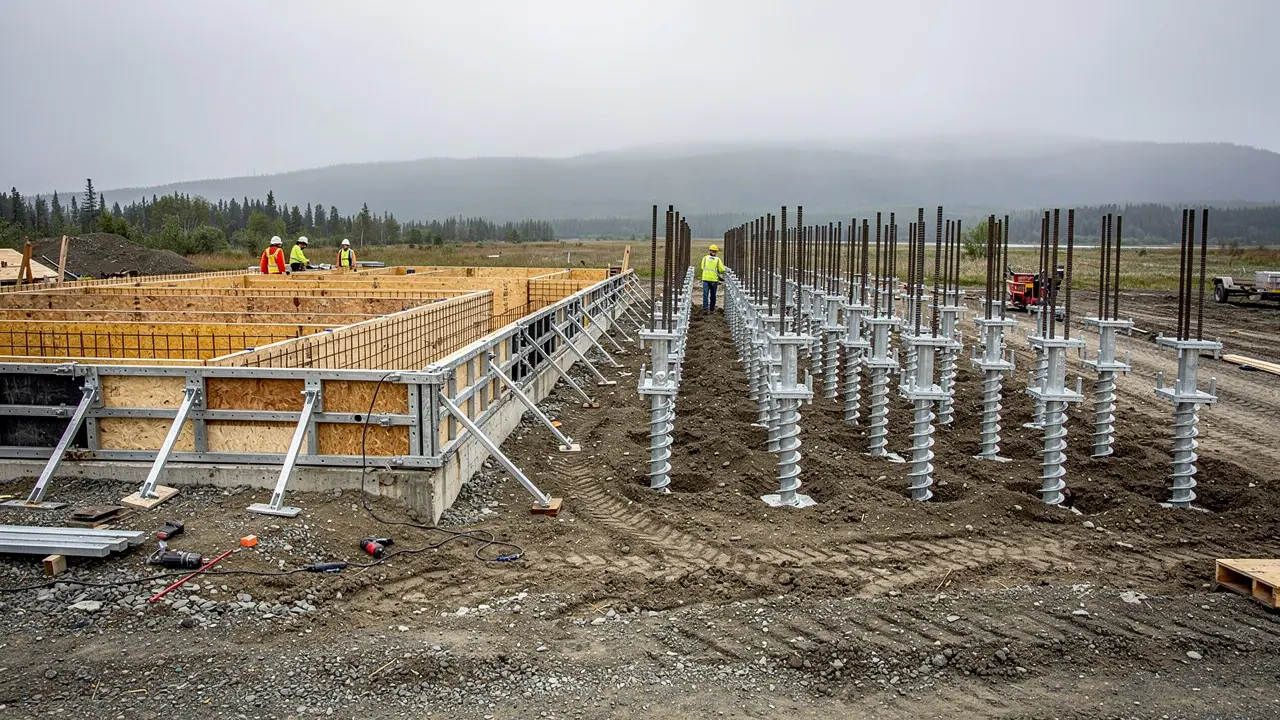
Screw piles (also called helical piles) are steel shafts with helical plates that get driven into the ground using hydraulic equipment. They anchor into load-bearing soil well below the frost line.
Pros:
- Installed in one to two days for a typical shop
- Can be installed year-round, including in frozen ground
- No curing time. You can build on them immediately
- Minimal site disturbance and no large excavation
- Excellent frost resistance since piles anchor below the frost line
Cons:
- You will need to add a floor separately (concrete slab on grade, or a raised floor system)
- Not ideal if you need a basement or below-grade storage
- Requires engineered pile layout for each project
For a deeper look at how screw piles work, see our complete guide to screw pile foundations.
Concrete Slab on Grade
A concrete slab is a flat pour of concrete, typically 4 to 6 inches thick, with thickened edges that act as the footing. It gives you a floor and a foundation in one step.
Pros:
- Provides a solid, smooth floor surface right away
- Great for heated shops, especially with in-floor radiant heat
- Handles heavy vehicle traffic and equipment loads well
- Familiar to most builders and straightforward to engineer
Cons:
- Requires excavation, gravel base, and proper compaction
- Needs warm weather or heated enclosures for pouring and curing
- Takes longer to complete, typically one to two weeks plus curing time
- More expensive than screw piles alone
- Vulnerable to frost heave if not designed properly for Peace Region frost depth
Concrete Perimeter Foundation
A perimeter foundation uses concrete footings and stem walls around the outside of the building, with the floor either poured as a separate slab inside or built as a raised floor system.
Pros:
- Very strong and durable for heavy commercial and industrial buildings
- Allows for a crawl space underneath for mechanical runs and storage
- Excellent for sites with challenging drainage or high water tables
- Works well for large heated shops that need deep frost protection
Cons:
- Most expensive foundation option
- Requires significant excavation and forming work
- Longest timeline, often two to three weeks for the foundation alone
- Season-dependent. Best poured in warmer months
Which Foundation Is Best for Your Shop?
The right choice depends on what you are building and how you plan to use it. Here is how we typically advise our clients:
- Cold storage or equipment shop: Screw piles with a gravel floor or a slab poured later. This is the fastest, most affordable option. You can be building within days of the piles going in.
- Heated workshop or hobby shop: Screw piles or concrete slab. If you want in-floor heat, a slab on grade is the way to go. If you want to get the building up fast and pour the slab after, screw piles let you do that.
- Large commercial or industrial shop: Concrete slab or perimeter foundation. Heavy equipment, vehicle traffic, and code requirements often make concrete the right call for bigger buildings.
- Farm shop or agricultural building: Screw piles are often the best fit. Fast, affordable, and they work well with post-frame and steel-frame shop construction.
Peace Region Soil and Frost Conditions
Soil conditions across the Peace Region vary quite a bit. Around Dawson Creek and Fort St. John, you will commonly find clay-heavy soils that hold moisture and are prone to frost heave. Frost depth in this area is typically 6 to 8 feet, which is deeper than most of southern BC.
This means any foundation needs to either extend below the frost line or be designed to handle frost movement. Screw piles anchor well below frost depth by design. Concrete foundations need properly engineered footings at the correct depth, and the slab needs adequate insulation and drainage underneath to prevent heaving.
If you are starting from a raw lot, proper site preparation and drainage are critical no matter which foundation you choose.
Frequently Asked Questions
Are screw piles cheaper than a concrete foundation?
For the foundation itself, yes. Screw piles are typically less expensive than a poured concrete slab or perimeter foundation. However, if you need a concrete floor anyway, the total cost may be similar. The big savings with screw piles come from speed and the ability to build in winter.
Can I pour a concrete floor on top of screw piles?
Yes. Many of our clients install screw piles first, build the structure, and then pour a concrete floor inside the finished building. This is a common approach for heated shops. It lets you get the building enclosed quickly and pour the slab in a controlled environment.
How do I know which foundation my site needs?
That depends on your soil, drainage, building size, and how you plan to use the space. We visit your site, look at the conditions, and recommend the best option. In most cases, we can tell you what will work after a quick site visit.
Do I need an engineer for my foundation?
For most shop foundations in the Peace Region, yes. Screw pile layouts are engineered based on soil conditions and building loads. Concrete foundations require engineered drawings for permits. We work with local engineers and handle this as part of the project.
Talk to Us About Your Foundation
Every site is different, and the best foundation for your shop depends on your land, your budget, and what you are building. Give us a call and we will come look at your property, talk through the options, and give you a straight answer on what makes the most sense. No pressure, just honest advice from a local general contractor who builds on these foundations every day.