Insulating Your Existing Shop
Signs Your Shop Needs Insulation
A lot of shops in the Peace Region were built as cold storage and later got a heater thrown in. That works for a while, but eventually the problems catch up. Here are the most common signs that your shop needs proper insulation:
- Condensation on walls and ceiling: When warm, moist shop air hits cold metal panels, water forms. You will see dripping, rust stains, and puddles on the floor.
- Frozen pipes or water lines: If your shop has plumbing and lines are freezing in winter, heat is escaping faster than your system can keep up.
- High heating bills: Running the heater constantly and still not getting comfortable means heat is pouring out through uninsulated walls and ceiling.
- Uncomfortable working conditions: Cold floors, cold walls radiating chill, and uneven temperatures throughout the building.
- Moisture damage to tools and equipment: Condensation causes rust on metal equipment, mould on stored materials, and corrosion on electrical components.
If any of these sound familiar, insulation will fix the root cause rather than just treating symptoms.
Best Insulation Options for Existing Shops
When you are retrofitting an existing building, your options are a bit different than new construction. Here is what works best:
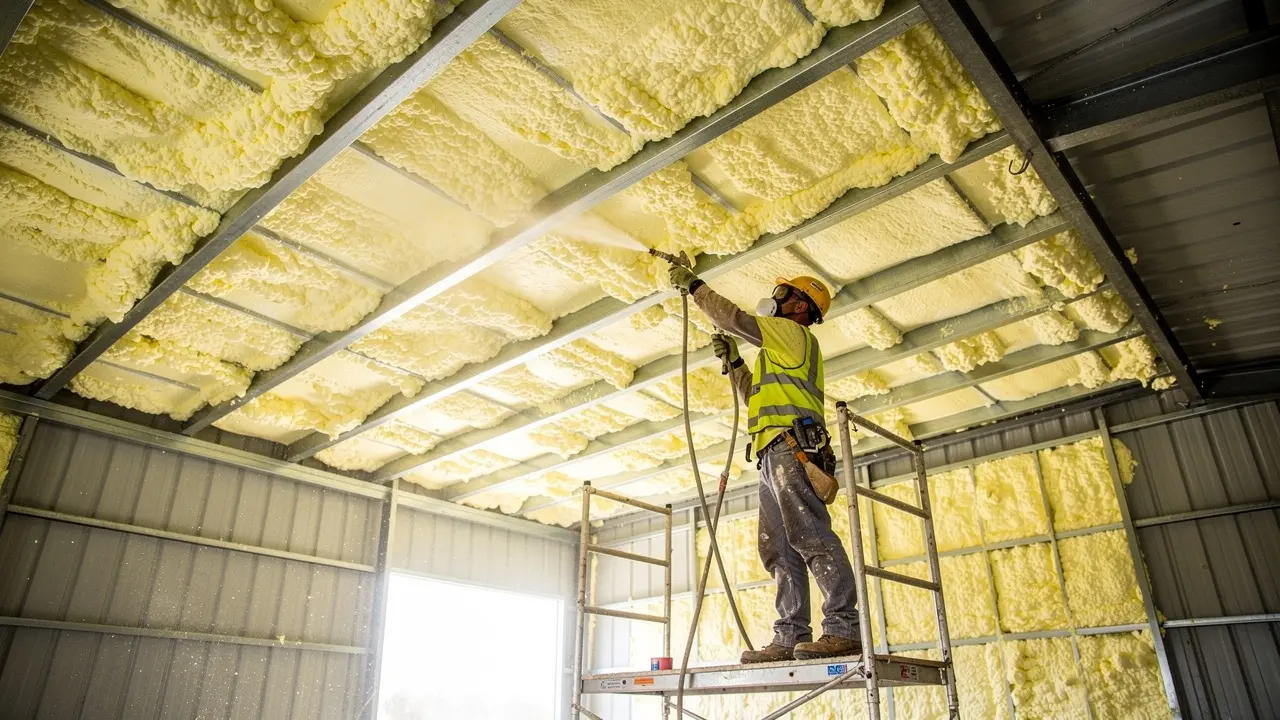
- Closed-cell spray foam: This is the best option for most existing shop retrofits. Spray foam insulation adheres directly to metal panels and wood framing, fills gaps and cracks, and acts as both insulation and vapour barrier. No need to tear anything apart to install it.
- Blown-in insulation: Blown-in insulation works well for ceilings and attic spaces where you have an enclosed cavity to fill. It is more affordable than spray foam per square foot but does not provide an air or vapour barrier on its own.
- Batt insulation: Fibreglass batts can be installed between framing members, but in a retrofit this usually requires adding framing to the inside of the walls. It is the most labour-intensive option for existing shops.
For a deeper comparison of the two most popular options, see our spray foam vs blown-in insulation guide.
Why Spray Foam Is Usually the Best Choice
For existing metal and post frame shops, closed-cell spray foam has several advantages that make it the go-to:
- No vapour barrier needed: Closed-cell foam is its own vapour barrier. This eliminates one of the trickiest parts of insulating an existing building.
- Conforms to irregular surfaces: Existing shops rarely have perfectly flat, uniform walls. Spray foam fills around purlins, girts, wiring, and any odd framing without gaps.
- High R-value per inch: Closed-cell spray foam provides about R-6 per inch. Two inches gives you R-12, which makes a major difference in a shop that previously had nothing.
- Air sealing: Spray foam seals all the small gaps and cracks where cold air infiltrates. Drafts are one of the biggest comfort problems in uninsulated shops, and foam eliminates them.
- Minimal disruption: The crew sprays directly onto the existing wall and ceiling panels. No need to remove cladding, add framing, or do major renovation work.
Insulating Walls, Ceiling, and Doors
A proper insulation retrofit covers all the surfaces where heat escapes. Here is what each area involves:
Walls: Spray foam is applied directly to the inside face of the wall panels, between and over the girts. Typical thickness is 2 to 3 inches of closed-cell foam. If you want to finish the interior with plywood or metal liner panels, framing can be added over the foam.
Ceiling: The ceiling or underside of the roof is usually the biggest source of heat loss. Spray foam is applied between the purlins and across the underside of the roof panels. For shops with open trusses, blown-in insulation above a ceiling plane is another option.
Overhead doors: Insulated overhead doors make a big difference. If your existing doors are single-skin steel, you can add insulation panels to the back of each section or replace the doors with factory-insulated units. Weatherstripping around all door edges is also important.
Man doors and windows: Check the seals on walk-in doors and any windows. Worn weatherstripping lets in a surprising amount of cold air.
Vapour Barrier Considerations
Vapour barrier mistakes are the main reason insulated shops still have condensation problems. Warm, moist air from inside the shop tries to move outward through the walls. If it reaches a cold surface before it hits a vapour barrier, it condenses and creates moisture problems.
Closed-cell spray foam solves this because the foam itself is a vapour barrier. With open-cell foam, blown-in, or batt insulation, you need a separate polyethylene vapour barrier on the warm side (interior side) of the insulation. Getting this detail wrong leads to hidden moisture, corrosion behind walls, and mould.
This is one of the biggest reasons we recommend spray foam for shop retrofits. It takes the guesswork out of vapour management.
What to Expect During the Process
Here is a typical timeline for insulating an existing shop:
- Assessment: We visit your shop, look at the existing construction, measure the space, and discuss your goals. This takes about an hour.
- Preparation: You will need to move items away from the walls and clear the areas being sprayed. Cover or remove anything you do not want overspray on.
- Installation: For a standard 30x40 shop, spray foam installation typically takes one to two days. The crew sets up the spray rig, masks off areas, and applies the foam in passes.
- Cleanup and finishing: After the foam cures (usually within a few hours), any overspray is trimmed. If you are adding liner panels or finishing, that work follows.
Most shop owners are surprised at how quick the process is. You can be back to using your shop within a day or two of the spray work.
Rough Costs
Insulation costs depend on the size of your shop, the type of insulation, and the thickness applied. Here are ballpark ranges for the Peace Region:
- Closed-cell spray foam (2"): $2.50 to $4.00 per square foot of surface area. For a 30x40 shop (walls and ceiling), this might total $8,000 to $14,000.
- Blown-in insulation (ceiling only): $1.50 to $2.50 per square foot. A ceiling-only job on a 30x40 shop might run $2,000 to $4,000.
- Insulated overhead doors (per door): $1,500 to $4,000+ depending on size and R-value.
These are rough numbers. The best way to get an accurate price for your shop is to give us a call and we will come take a look.
Frequently Asked Questions
Can I insulate my shop in winter?
Yes. Spray foam can be applied in winter as long as the building is enclosed. We use temporary heating to bring the shop up to the minimum application temperature. Many clients insulate in fall or early winter so they can heat the shop efficiently through the cold months.
Will insulation fix my condensation problem?
In most cases, yes. Condensation happens when warm air meets a cold surface. Insulation keeps the interior surfaces warm, which eliminates the conditions that cause condensation. Proper vapour barrier placement is also critical.
Do I need to insulate the floor?
For most shops, insulating the walls and ceiling makes the biggest difference. Floor insulation is less common in shop retrofits unless you are installing in-floor heating. A concrete slab retains some ground heat and is usually acceptable without insulation.
How much will I save on heating?
It depends on your current situation, but most shop owners see a significant reduction in heating costs. An uninsulated metal shop can lose heat 5 to 10 times faster than an insulated one. The insulation typically pays for itself within a few winters.
Can I do the insulation myself?
Batt insulation is a reasonable DIY project. Spray foam requires specialized equipment, training, and safety gear, so it is best left to professionals. The quality of the spray application directly affects performance, and mistakes are difficult to fix.